

April 17, 2026 • Business, Healthcare, Nonprofit
8 Tips to Rank on AI Search Fast Using SEO
AI Search Is Changing How People Find You — Here’s What to Do About It
To rank on AI search, focus on these core steps:
- Write direct, answer-first content that AI can easily extract and cite
- Use structured data (FAQPage, HowTo, Organization schema)
- Build topical authority with content clusters around your core services
- Integrate precision-targeted paid campaigns to amplify organic signals
- Allow AI crawlers access in your robots.txt file
- Keep content accurate, up-to-date, and consistent across all platforms
- Earn mentions and citations on trusted third-party sites, forums, and directories
- Optimize your Google Business Profile and maintain consistent NAP (name, address, phone)
Search has shifted. As of March 2026, over 65% of Google results pages now include AI Overviews — up from just 25% in August 2024. That means AI is no longer a future trend. It is the current reality of how your audience finds information.
For healthcare organizations, non-profits, and mission-driven brands, this shift is especially significant. When someone searches for a specialist, a treatment option, or a trusted provider, AI tools like Google AI Overviews, ChatGPT, and Perplexity are increasingly delivering a single synthesized answer — not a list of ten blue links. If your brand is not in that answer, you are effectively invisible.
The good news: the fundamentals that build trust with humans also build visibility with AI. Accurate, well-structured, authoritative content wins. Keyword tricks and thin pages do not.
I’m Madeline Jack, Chief Client & Operations Officer at Blink Agency, where I help healthcare and mission-driven organizations build marketing ecosystems that drive real growth. While basic optimizations can be handled in-house, Blink Agency offers full management of these complex ecosystems to ensure your brand remains the definitive answer. In this guide, I’ll walk you through the exact steps needed to rank on AI search and stay there.
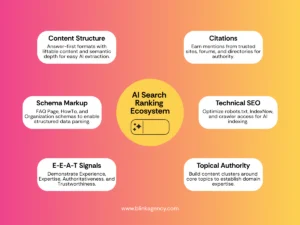
Rank on AI Search
Core Strategies for How to Rank on AI Search
In traditional SEO, we used to obsess over keyword density and backlink counts. While those still matter, AI search engines—often called Answer Engines—prioritize something different: synthesis. These models don’t just find a page; they read it, summarize it, and decide if it’s trustworthy enough to represent as a fact to a user.
To succeed, we have to move beyond “optimizing for keywords” and start “optimizing for answers.” This involves a shift toward strategies that prioritize clarity and structured authority. According to How to Rank in AI Search Results (The Definitive Playbook), the fastest way to gain visibility is to make your content “liftable”—meaning an AI can easily grab a paragraph and use it as a standalone answer.
Content Architecture to Help You Rank on AI Search
The way we build pages in 2026 is vastly different from 2024. AI models like ChatGPT and Google Gemini use Retrieval-Augmented Generation (RAG) to pull information. If your content is buried in long, rambling stories, the AI will skip it. We recommend an “inverted pyramid” or “answer-first” structure.
- Direct Answers: Start your sections with a clear, 50–75 word summary that directly answers the heading’s question. This is prime real estate for AI citations.
- Semantic Depth: Don’t just mention a topic; cover the entities around it. For a healthcare provider, this means linking symptoms, treatments, and recovery times in a logical flow.
- FAQ Formats: AI search is conversational. By using a Q&A format, you are essentially pre-writing the answer for the AI.
- Liftable Formatting: Use bulleted lists, numbered steps, and clear bulleted comparisons. These are highly “extractable” and often appear in the “featured” sections of AI Overviews.
Implementing these 5 Healthcare Marketing Strategies Driving Industry Change ensures your site acts as a reliable data source for these models.
Technical Foundations to Help You Rank on AI Search
If content is the “what,” technical SEO is the “how.” AI bots need to be able to find and understand your data quickly.
- Schema Markup: This is your “translator” for AI. Use
FAQPage,HowTo, andOrganizationschema to label exactly what your content is. - Robots.txt: Ensure your robots.txt file allows agents like
GPTBot,OAI-SearchBot, andGoogle-Extended. DIY Tip: You can manually check your robots.txt file by adding “/robots.txt” to the end of your domain to ensure these bots aren’t accidentally blocked. - IndexNow: Use IndexNow to instantly notify search engines (especially Bing, which powers much of ChatGPT’s web browsing) when you update content.
- Site Speed: Aim for load times under two seconds to ensure the bot—and the user—doesn’t bounce. You’d be surprised how something as simple as site speed helps you rank in AI search.
While these DIY steps are a great start, Blink Agency provides full-scale management to handle the complex technical nuances of AI optimization. For a deeper dive into these technical requirements, check out our latest Insights and the AI Overviews Optimization Guide: How to rank in generated results.
Frequently Asked Questions About How to Rank on AI Search
Q1: How long does it take to rank on AI search results? Unlike traditional SEO which can take months, you can often rank on AI search faster by using high-authority citations. Some brands see visibility changes in weeks.
Q2: What is the most important factor to rank on AI search? The most critical factor is Content Architecture. Your content must be “liftable,” meaning it uses structured data and clear headings so AI models can easily extract and cite your information.
Q3: Can small brands rank on AI search against larger competitors? Yes. AI search prioritizes accuracy and directness over domain age. By focusing on niche expertise and proper schema, smaller brands can often outperform larger ones in specific AI Overviews.
Advanced Tactics for AI Visibility and Authority
Once your site is technically sound, you need to build what we call “Entity Authority.” AI doesn’t just look at your website; it looks at the whole internet to see what others say about you. This is where Precision Targeted Campaigns become essential for building a cohesive brand voice for healthcare clients.
Scaling with Precision-Targeted AI Campaigns
At Blink Agency, we know that SEO is only one piece of the puzzle. To truly dominate a market, you need to combine organic visibility with precision-targeted acquisition. We use a proprietary, HIPAA-compliant AI platform that reaches 250M US adults, allowing us to target your ideal customer with precision.
Whether you are looking to launch an AI Patient Acquisition Campaign or build a long-term GEO strategy, we focus on the data that matters. We do more than help you appear in AI search results; we manage the full process so your brand becomes the trusted answer that turns searchers into customers, clients, or partners.