

April 17, 2026 • Healthcare
Precision Targeted Healthcare Campaigns: A Better Way to Connect
Why Precision Targeted Healthcare Campaigns are Essential
Precision targeted healthcare campaigns are a marketing approach that uses advanced data and technology to deliver highly specific, personalized ads to carefully chosen groups of patients or healthcare professionals. By utilizing precision targeted healthcare campaigns, organizations can significantly cut waste and boost engagement.
If you’re wondering what precision targeted healthcare campaigns mean for your organization, here’s a quick overview:
- Pinpoint Accuracy: Instead of broad outreach, these campaigns reach the exact people most likely to need your services.
- Data-Driven Decisions: They rely on rich data sources (like real-world data and claims data) combined with AI to find precise audiences.
- Personalized Messages: Ads are tailored, making them much more relevant and effective for the recipient.
- Privacy First: It strictly follows privacy rules, especially HIPAA, ensuring patient data is protected.
- Better ROI: By focusing on the right audience, it helps marketers get more from their advertising budget.
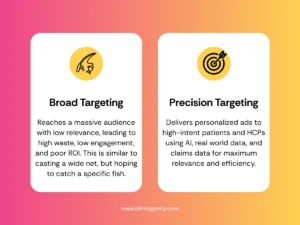
In today’s fast-changing digital world, traditional, broad marketing often misses the mark. It’s like casting a wide net hoping to catch a specific fish. The digital landscape, with its focus on data privacy and strict rules, demands a smarter approach. This is why precision in healthcare advertising has moved from a nice-to-have to a must-have. It helps connect the right people with the right care, at the right time.
At Blink Agency, we see how crucial precision targeted healthcare campaigns are for driving measurable growth. Our approach uses AI-powered insights and data-backed decisions to help healthcare organizations connect with high-intent audiences, improve campaign efficiency, and build trusted brands.
Mastering Precision Targeted Healthcare Campaigns
The shift from “spray and pray” marketing to precision targeted healthcare campaigns isn’t just a trend; it’s a fundamental evolution. In the past, a pharmaceutical company might buy a TV spot during the evening news, hoping that a fraction of the viewers had the condition they treated. Today, programmatic advertising accounts for 46% of total healthcare ad spend, officially surpassing traditional TV.
To master these strategies, we rely on a combination of Artificial Intelligence (AI) and high-quality data. Unlike traditional methods that use broad demographics (like “women aged 35-50”), precision targeting utilizes Real-World Data (RWD) and claims data. This includes information from doctor’s visits, hospital stays, and prescriptions filled, allowing us to identify patterns without ever compromising individual identity.
Traditional targeting casts a wide net. It usually relies on broad demographic filters like age and gender, plus third-party cookies or survey data. That approach often creates more waste, weaker engagement, and messaging that feels generic.
Precision targeted healthcare campaigns work differently. They focus on clinical propensity, real-world behavior, and richer data inputs such as claims data, real-world data, and AI modeling. The result is more efficient media spend, far less waste, and in many cases significantly stronger return on ad spend. It also supports a privacy-by-design approach, using compliant methods rather than invasive tracking, while making it easier to deliver messaging that is relevant, contextual, and tailored to the audience.
By leveraging these advanced models, we can identify “audiences within audiences.” For example, instead of targeting everyone with diabetes, we can segment the audience into newly diagnosed patients, those at risk of non-adherence, or those likely to progress to a new line of therapy. This level of granularity is what drives 5 Healthcare Marketing Strategies Driving Industry Change.
Implementing Precision Targeted Healthcare Campaigns for Patients
Reaching patients requires a delicate balance of empathy and technology. We use Predictive AI to look at the “inflection points” in a patient’s journey. Is a patient likely to become non-adherent to their medication in the next 30 days? Are they currently undiagnosed but showing symptoms that align with a specific rare condition?
Our AI Patient Acquisition Campaign Service uses these predictive models to find the “hidden” patients who need care the most. For rare conditions, high-quality segments can be 100 to 5,000 times more targeted than general population samples. This isn’t just about selling a product; it’s about 4 Ways Digital Marketing for Healthcare Enhances Patient Care by connecting individuals to the specific medical resources they need.
To ensure this is done ethically, we employ K-anonymity and use de-identified data. K-anonymity is a scientific process that ensures an individual cannot be re-identified within a data set because they are “hidden” among at least “k” other people with similar traits. This allows us to target a “propensity” rather than a specific person’s private medical record.
Precision Targeted Healthcare Campaigns for Healthcare Professionals (HCPs)
Targeting HCPs is a different beast entirely. Doctors are busy, suffer from “channel fatigue,” and are bombarded with information. Traditional methods often rely on static NPI (National Provider Identifier) lists, which can lead to wasted impressions.
Modern precision targeted healthcare campaigns for HCPs work best when you combine provider specialty with real-world intent signals. By pairing factors like specialty, search history, practice size, and clinical behavior, marketers can find the right healthcare professionals more accurately. Network mapping also helps uncover connected care teams and influential providers, so messaging reaches the HCPs most likely to shape treatment decisions.
It is also important to remember that healthcare is a team sport. We don’t just target the physician; we engage the entire care team, including nurse practitioners, physician assistants, and nurse navigators. These professionals often spend the most time on patient education and adherence support. When deciding Which Targeting Option is Best for Achieving Brand Awareness?, it’s clear that a multi-layered approach—targeting by NPI, medical specialty, and clinical behavior—yields the best results.
Navigating Privacy and HIPAA Compliance
In our industry, privacy isn’t just a legal requirement; it’s the foundation of trust. Any precision targeted healthcare campaign must be strictly HIPAA-compliant. This means Protected Health Information (PHI) never enters the advertising ecosystem. Instead, we use “Privacy-by-Design” frameworks.
We look for certifications like HITRUST, which provides a common security framework for handling sensitive health information. One of the most effective ways to maintain privacy is through tokenization, where sensitive data is replaced with a non-sensitive equivalent (a token) that has no extrinsic value. This allows us to track campaign effectiveness without ever “seeing” the patient’s identity.
In healthcare precision targeting, protecting the patient relationship has to come first. That means using privacy-first methods like de-identified audience groups, tokenization, and secure data handling to connect people with relevant medical information without exposing personal identities. Done well, this supports better outreach while helping 5 Ways Data-Driven Decision-Making Improves Patient Access stay possible without crossing privacy lines.
Optimizing Performance and Measuring Success
A campaign is only as good as its results. In precision targeting, we move beyond “vanity metrics” like clicks or impressions. We focus on Audience Quality (AQ) and actual clinical outcomes.
To run a high-performing campaign, we focus on the 6 Components of Successful Healthcare Marketing Campaigns. This includes:
- Clear Objectives: Are we driving diagnoses, brand switches, or adherence?
- High-Quality Data: Using RWD and AI-driven data to find the right audience.
- Compelling Creative: Tailoring the message to the specific segment (e.g., newly diagnosed vs. long-term care).
- Omnichannel Activation: Reaching the audience across social, display, CTV, and point-of-care.
- Continuous Optimization: Adjusting the campaign in real-time based on performance.
- Closed-Loop Measurement: Linking ad exposure to actual prescriptions or appointments.
Our Our Services are designed to handle this complexity, ensuring that every dollar spent is working toward a measurable goal.
Adapting to a Cookie-less Advertising Landscape
The “avalanche” has already started. With Apple’s App Tracking Transparency (ATT) leading to 96% of users declining tracking, and Google phasing out third-party cookies in its “Privacy Sandbox,” traditional behavioral targeting is dying.
We also keep a close eye on 6 Healthcare Marketing Trends to Watch in 2025. One major trend is the rise of “Platform-Native” funnels. On platforms like Meta, we use in-platform signals—like video completion rates or lead form interactions—as proxy conversions. This keeps the data within a controlled environment, which is often a safer bet for Patient Engagement Service strategies.
Measuring ROI and Conversion Lift
How do you know if it is working? Focus on ROI and conversion lift, not just vanity metrics. With closed-loop attribution, you can connect ad exposure to meaningful actions like appointment requests, form fills, site engagement, and qualified patient inquiries.
For example, a “Bottom-Up” targeting strategy using AI-driven claims data has been shown to lead to a 35% increase in diagnoses for certain conditions. Similarly, campaigns using highly defined target audiences see up to 10 times higher return on ad spend (ROAS).
As noted in Precision Marketing in Healthcare: Transforming Patient … – IQVIA, the “one-size-fits-all” approach is over. Success is now measured by media efficiency—how little is wasted while reaching the people who truly need the treatment. This focus on outcomes is central to how we approach the Healthcare Industry.
Scaling with Blink Agency’s AI Platform
At Blink Agency, we don’t just talk about precision; we built the engine that drives it. We are an AI-driven growth and acquisition agency that helps healthcare organizations, businesses, and nonprofits connect with their ideal audiences.
Our proprietary, HIPAA-compliant AI platform allows us to reach 250 million US adults with surgical precision. We don’t rely on outdated cookies or broad guesses. Instead, our platform uses advanced algorithms to identify high-intent audiences as they are searching for care. This allows us to deliver the right message at the exact moment it’s needed most.
Whether you are looking to accelerate rare disease diagnoses, improve patient adherence, or recruit top-tier HCPs, our platform provides the scale and security required for modern healthcare. You can see the impact of our approach by exploring Our Services or reading through Our Services to see how we’ve helped others achieve 30:1 ROI and beyond.
Ready to see what a precision targeted healthcare campaign can do for your brand? We invite you to explore Which Targeting Option is Best for Achieving Brand Awareness? or check out Healthcare Industry to learn more about our specialized approach. Let’s work together to build a healthier, more connected future.