

April 24, 2026 • Healthcare
How to Choose the Best Medical Practice Website Builder for Your Clinic
Your Website Is Your Digital Front Door — Make It Count
A medical practice website builder is a platform designed specifically to help healthcare providers create websites that earn patient trust, handle sensitive data safely, and turn visitors into booked appointments.
Choosing the right platform is critical. A high-performing medical site must balance workflow-first intake, HIPAA compliance, and professional design that reflects the quality of care provided. However, most generic builders weren’t built with healthcare in mind. They often lack the secure patient portals, encrypted forms, and structured content systems that medical practices actually need to operate safely and efficiently.
The stakes are real. Over 77% of patients search online before booking an appointment — and nearly 60% say a provider’s website directly influences whether they trust that practice. Your website isn’t just a marketing page. It’s part of the care experience.
Getting it wrong doesn’t just cost you patients. It can create compliance exposure and erode the credibility you’ve spent years building.
I’m Madeline Jack, Chief Client & Operations Officer at Blink Agency, where I’ve helped healthcare organizations cut through the noise by building marketing ecosystems — including the right medical practice website builder strategy — that drive real patient acquisition. In this guide, I’ll walk you through everything you need to make a confident, informed decision.
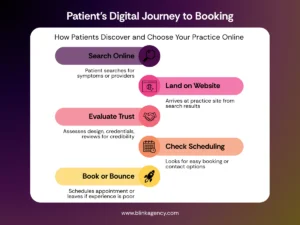
Why Your Clinic Needs a Specialized Medical Practice Website Builder
When you use a generic website builder, you are essentially trying to fit a square peg into a round hole. While a local bakery needs a site that looks “tasty,” your clinic needs a site that looks “trustworthy.” Research indicates that over 77 percent of patients search online before booking an appointment, making your digital presence the primary factor in their decision-making process.
The difference lies in operational maturity; a high-quality medical practice website builder prioritizes risk sensitivity and information architecture over flashy, generic animations. In healthcare, credibility is built through clarity. Patients aren’t looking for a “deal”; they are looking for reassurance. This means your site must provide:
- Structured Content: Consistent doctor profiles, clear service descriptions, and organized FAQs that help patients find answers quickly.
- System-First Architecture: Unlike e-commerce sites that push for a quick sale, medical sites must handle complex patient intake workflows and conditional routing.
- Reliability: A broken link on a retail site is an annoyance; a broken “Book Now” button on a medical site is a lost patient and a damaged reputation.
Digitally enabled practices see higher acquisition efficiency and lower administrative friction. By choosing a tool built for medicine, you ensure your “digital front door” is as professional as your physical office.
Essential Features for Patient Trust and Compliance
Building a medical website isn’t just about aesthetics; it’s about adhering to strict legal and ethical standards. If your builder doesn’t support these core features, you’re putting your practice at risk.
HIPAA Compliance and Data Security
Any interactive feature that handles patient data—like appointment requests or contact forms—must be HIPAA-compliant. This involves end-to-end data encryption and secure hosting environments. Without this, you risk heavy fines and a total loss of patient privacy.
Accessibility and WCAG Standards
Inclusivity is non-negotiable in healthcare. WCAG 3.0 guidelines require a contrast ratio of at least 4.5:1 for all text and graphics to ensure those with visual impairments can read your content. Your medical practice website builder should also support:
- Descriptive Alt-Text: Helping screen readers describe images to patients.
- Keyboard Navigation: Ensuring patients who can’t use a mouse can still navigate your site.
- Accessibility Widgets: Allowing users to adjust text size or switch to high-contrast modes.
Interactive Patient Tools
To reduce the burden on your front-desk staff, your website should function as a self-service hub. Essential tools include:
- Online Scheduling: Allowing patients to book 24/7.
- Secure Patient Portals: A protected area for patients to view records or message providers.
- Telehealth Integration: A must-have for modern follow-up care.
- Multi-language Support: Ensuring your care is accessible to diverse populations.
- Online Bill Pay: Streamlining the transactional side of your practice.
Tailoring Your Online Presence: Why Professional Web Design is Essential for Every Practice Size
While DIY builders offer a starting point, they often lack the depth required to scale a growing practice. This is where professional Web Design becomes a strategic investment rather than a cost.
Solo Practitioners: Efficiency and Local Visibility
For a solo doctor, time is the most precious resource. You need a site that works as a 24/7 salesperson. Expert design ensures your site is optimized for local SEO, helping you appear at the top of search results when a patient looks for a specialist “near me.” A professional approach allows you to launch quickly without sacrificing the trust signals—like professional imagery and clear credentials—that patients demand.
Multi-Location Clinics: Scalability and Consistency
As a practice grows, the complexity of its website increases exponentially. Scaling a multi-location group requires a medical practice website builder that can handle complex routing and location-specific SEO without losing brand consistency. Multi-location groups need specialized web design to ensure brand consistency across every branch. You need dedicated, SEO-optimized pages for each location and a workflow-driven intake system that routes patient requests to the correct office automatically.
Ownership and Long-Term Maintenance
One of the biggest risks of DIY builders is “platform lock-in.” If you outgrow the builder, moving your data can be a nightmare. Working with a dedicated partner ensures you have long-term ownership of your digital assets. We focus on building robust system-level architecture that evolves with your practice, ensuring that as patient volume increases, your site doesn’t fall apart under the pressure.
Design Best Practices for High-Conversion Healthcare Sites
A high-performing medical website must balance beauty with functionality. Here are the pillars of effective healthcare design:
- Mobile-Friendliness: Nearly 90 percent of the global internet population uses a mobile device to go online. If your site doesn’t resize perfectly on a smartphone, you are losing more than half of your potential patients.
- Easy Navigation: 94% of consumers say easy navigation is the most important website feature. If a patient can’t find your “Services” or “Contact” page within seconds, they will leave.
- Load Speed: Large, uncompressed images can kill your site’s performance. Compressing images can save up to 1MB of load time, which is critical for keeping impatient visitors on your page.
- Authentic Imagery: Posts that include images produce 650% higher engagement rates than text-only posts. Avoid generic stock photos; use original photos of your team and facility to build a real human connection.
- Content Marketing: Don’t just publish blog posts; use your medical practice website builder to create a resource hub that positions you as an authority while lowering patient acquisition costs.
- Clear Call-to-Action (CTA): Every page should have a clear next step, whether it’s “Call Now,” “Book an Appointment,” or “Download Patient Forms.”
Frequently Asked Questions about Medical Website Building
How much does a medical practice website builder cost?
The cost varies based on your practice’s needs. A basic DIY setup might start with a small monthly fee, but professional, patient-acquisition-focused solutions typically start around $5,000. Remember to factor in ROI: a well-designed site acts as a commission-free salesperson that works 24/7.
Is every medical practice website builder HIPAA compliant?
No. Many popular generic builders are not HIPAA-compliant out of the box. They may require expensive third-party plugins or specific enterprise-level plans to handle patient data safely. It is critical to choose a platform or a partner that understands compliance-aware architecture to avoid regulatory risks.
How long does it take to launch a medical practice website builder project?
A standard medical website for a small to medium practice typically takes about 30 days to launch, provided your content and branding are ready. More complex, multi-location projects with deep system integrations can take up to 90 days. Preparation is key—having your provider profiles and insurance lists ready can significantly speed up the process.
Can I keep my current patient portal and EHR in my new website?
Yes. A professional medical website should seamlessly integrate with your existing Electronic Health Record (EHR) and patient portal via API or secure “Quick Links,” ensuring a unified experience for both your staff and your patients.
Who actually owns the website and the domain name?
You should always maintain 100% ownership of your domain and website content. At Blink Agency, we believe in partnership, not “platform lock-in,” ensuring you have full control over your digital assets as your practice grows.
How does the website help with my local Google ranking?
A specialized builder uses “schema markup”—a backend language that tells Google exactly what services you offer and where you are located. This, combined with fast load speeds and mobile optimization, significantly increases your visibility in local search results.
Do I need to write all the medical content myself?
While your clinical expertise is vital for accuracy, you don’t have to start from scratch. We provide content frameworks and AI-assisted drafting tailored to healthcare SEO, which you can then review and approve to ensure it reflects your practice’s voice.
Conclusion
Choosing the right medical practice website builder is the first step in turning your digital front door into a high-performance patient acquisition engine. At Blink Agency, we specialize in helping healthcare providers bridge the gap between medical expertise and digital growth. Our AI-driven, HIPAA-compliant platform is designed for precision-targeted campaigns that reach 250M US adults, ensuring your practice doesn’t just have a website, but a powerful engine for patient acquisition.
Ready to build a digital front door that reflects the quality of care you provide? Start your medical website transformation with us today and let’s turn your online presence into your practice’s greatest asset.